Shards of Evidence: What Broken Pottery Is Teaching Us About Eastern Woodland Mobility and Exchange
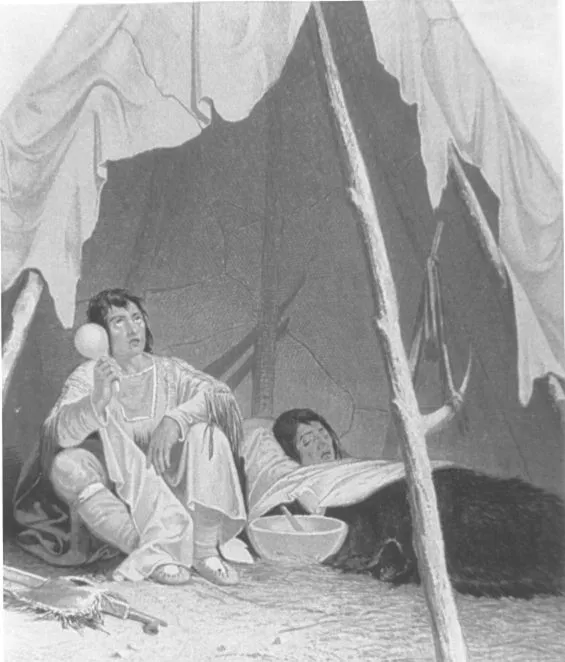
Photo: Captain Samual Eastman, Public domain, via Wikimedia Commons
For much of the twentieth century, the Eastern Woodland peoples of pre-contact North America were portrayed in academic literature as occupying discrete, largely self-contained cultural zones. The geography itself seemed to support this interpretation: dense forest, river valleys that ran in inconvenient directions, and the apparent absence of monumental road infrastructure all suggested limited long-range interaction. Pottery, when it entered the conversation at all, was treated primarily as a stylistic marker — a way of sorting cultures into tidy taxonomic boxes. That interpretive framework is now under serious pressure.
A growing body of research employing refined ceramic typology alongside sophisticated residue analysis is producing evidence that Eastern Woodland communities moved, traded, and communicated across distances that earlier scholars would have found implausible. The pottery they left behind — cracked, buried, and fragmentary — is proving to be one of archaeology's most revealing documentary sources.
The Limits of Style-Based Classification
Traditional ceramic analysis in Eastern Woodland archaeology relied heavily on visible stylistic attributes: vessel shape, surface treatment, decorative motifs, and temper composition. These attributes allowed researchers to assign sherds to recognized cultural traditions — Woodland, Mississippian, Late Archaic — and to map their geographic distribution. The method was productive, but it carried an embedded assumption: that stylistic similarity meant geographic proximity, and that stylistic difference meant cultural separation.
The problem, as researchers have increasingly recognized, is that style travels. A pot made in one community can end up in another through gift exchange, marriage alliance, trade, or migration. Worse, potters themselves move, carrying their techniques and aesthetic sensibilities into new communities where they may teach, adapt, or blend their practices with local traditions. Style-based classification, applied without additional analytical tools, cannot distinguish between these scenarios.
This is precisely where residue analysis and compositional sourcing have begun to transform the field.
Reading What the Vessel Carried
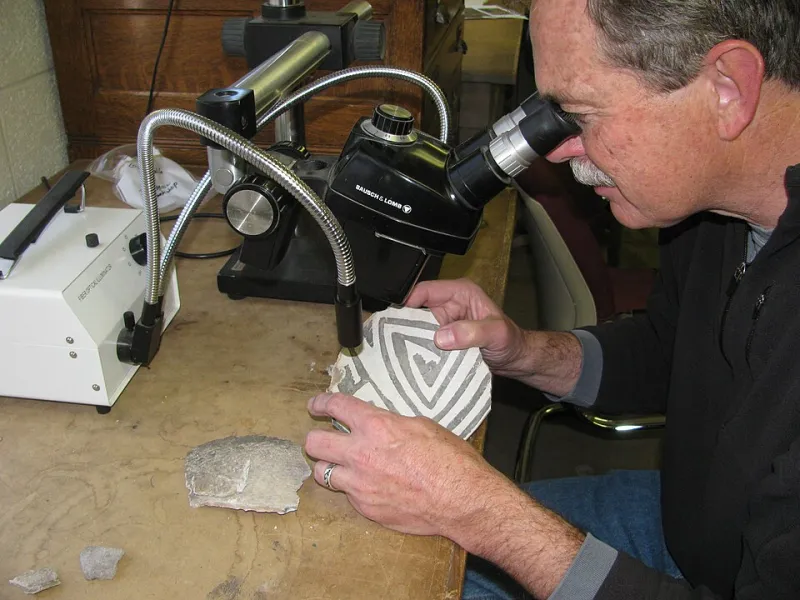
Organic residue analysis — the chemical examination of substances absorbed into the walls of ceramic vessels — has opened a direct window into ancient use patterns. Researchers extracting lipid residues from pottery recovered at sites across the Ohio River Valley and the Great Lakes region have identified the chemical signatures of foodstuffs, plant-based substances, and in some cases, materials not locally available. When a vessel recovered in what is now southern Ohio yields residues consistent with marine fish oils, questions about how it got there become unavoidable.
At the Holding site in Illinois, ceramic assemblages dating to the Late Woodland period have yielded vessels whose clay compositions, determined through instrumental neutron activation analysis (INAA), do not match local geological sources. Sourcing studies have traced some of these clays to deposits in Tennessee and Kentucky. The vessels were not stylistic imitations of distant wares — they were the actual products of those distant locations, transported intact across hundreds of miles.
Similar findings have emerged from sites associated with the Hopewell interaction sphere, the remarkable network of exchange that flourished in the first through fifth centuries CE. While Hopewell's long-distance connections have long been acknowledged — copper from the Great Lakes, mica from the Appalachians, marine shells from the Gulf Coast — the role of pottery in that network has historically been underplayed. Recent compositional studies suggest that ceramic vessels were themselves objects of value in Hopewell exchange, not merely containers for other goods.
Challenging the Sedentary Assumption
Perhaps the most significant implication of the new ceramic evidence concerns mobility itself. The received model of Eastern Woodland settlement emphasized semi-sedentary village life, with populations tethered to agricultural fields and local resource patches. Migration, when acknowledged, was typically framed as episodic and crisis-driven — a response to drought, conflict, or resource depletion.
The ceramic data complicate this picture substantially. At multiple sites in the Middle Ohio Valley, researchers have documented what are termed "intrusive" ceramic assemblages — clusters of pottery whose technological and compositional profiles are entirely inconsistent with the surrounding local tradition. These assemblages do not appear to represent trade goods; their domestic character, including cooking residues and evidence of repair, suggests they were brought to the site by people who made and used them elsewhere.
Dr. Penelope Driscoll, a ceramic archaeologist whose work focuses on Late Woodland period sites in Kentucky and Indiana, has argued that these assemblages reflect residential movement by small family or kin groups rather than wholesale population displacement. "What we're seeing," she noted in a 2021 paper published in the journal Midcontinental Journal of Archaeology, "is evidence of a much more fluid social landscape than the village-centered models have allowed for. People were moving, and they were taking their pots with them."
The Significance of Temper
Beyond clay sourcing and residue analysis, the study of temper — the non-plastic material potters mix into clay to reduce cracking during firing — has yielded its own surprises. Potters typically selected temper from locally available materials: crushed granite, shell, grit, or fired clay fragments known as grog. When a vessel's temper composition does not match the geological environment of its recovery site, the mismatch demands explanation.
At sites along the Tennessee River drainage, researchers have identified vessels tempered with limestone crushed in a manner consistent with traditions practiced in communities to the north, in what is now the Kentucky Bluegrass region. These vessels appear in domestic refuse contexts, not ceremonial deposits, which argues against their interpretation as prestige imports. The most parsimonious explanation is that the people who made them — people from the Bluegrass — were present at Tennessee River sites, living, cooking, and discarding pottery alongside local populations.
This kind of evidence is quietly rewriting the social geography of pre-contact Eastern North America. The boundaries between cultural traditions, always somewhat artificial constructs of academic classification, are beginning to look even more permeable than critics of the old typological frameworks had suspected.
Implications for Understanding Pre-Contact Society
The broader significance of these findings extends well beyond ceramic studies. If Eastern Woodland peoples were engaged in sustained, long-distance movement and exchange — not as exceptional behavior but as a routine feature of social life — then many of the interpretive frameworks built on sedentary assumptions require revision.
Kinship networks, alliance structures, information exchange, and the spread of technological innovations all look different when the human actors involved are understood to have been geographically mobile. The adoption of maize agriculture, the spread of specific ritual practices, and the emergence of shared symbolic vocabularies across large regions all become easier to explain when movement and contact are treated as normal rather than exceptional.
For students and researchers approaching Eastern Woodland archaeology, the methodological lesson is equally important. No single analytical technique tells the complete story. Ceramic typology, residue analysis, temper sourcing, and contextual interpretation must work in concert, each constraining and informing the others. The pottery puzzle, as it turns out, is not a puzzle with a single solution — it is an invitation to ask better questions about the people who made, carried, used, and ultimately left behind the broken vessels that archaeologists are still learning to read.