Playing for Keeps: The Ritual Ballgame at the Heart of the Mississippian World
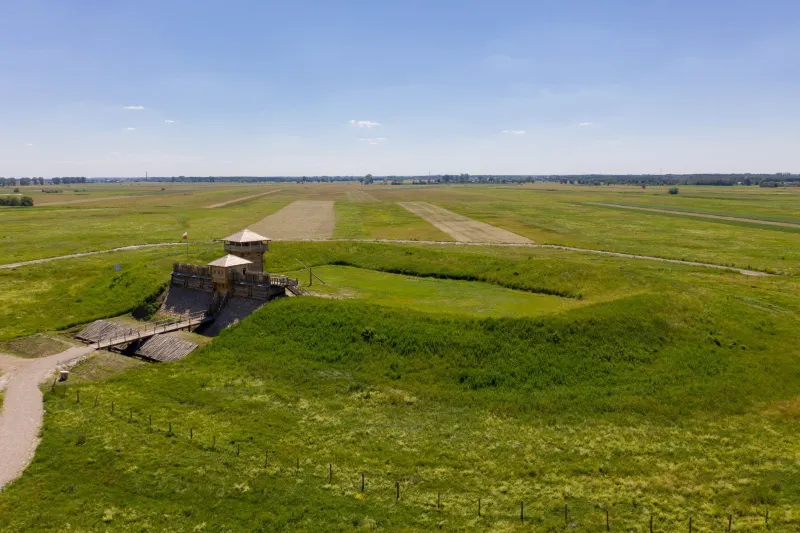
In the twelfth century, the sprawling plazas of Cahokia—today a UNESCO World Heritage site just east of St. Louis—hosted gatherings that drew thousands. Among the ceremonies, feasts, and markets, one event stood apart: a ballgame played with a leather-covered stone, contested on open ground that archaeologists are only now learning to identify.
A Game Written in Stone and Earth
Unlike the arid Southwest, where rubber balls and court structures survive, the humid Southeast has erased nearly all organic traces of the Mississippian game. What remains are indirect but telling clues. Small carved stone discs, often called chunkey stones, have surfaced at sites from Illinois to Georgia—disc-shaped artifacts with concave faces that scholars initially associated with the game of chunkey, a hoop-and-spear contest observed by Europeans centuries later.
Reinterpreting these artifacts has become a central project of Mississippian archaeology. Ethnohistoric accounts, including the sixteenth-century narratives of the de Soto expedition, describe ballgames in which hundreds of men and women competed, sometimes as diplomatic contests between rival polities. When excavators at the Etowah site in Georgia and Moundville in Alabama identified broad, level plaza spaces flanked by mounds, they recognized a pattern: architecture designed not for dwelling, but for display—and perhaps for play.
Politics on the Field
The ballgame was never merely recreation. Mississippian societies were hierarchical, organized under paramount chiefs whose authority needed constant public performance. A match offered precisely that stage. Victory in a game between communities could cement alliances, avert warfare, or humiliate a rival without bloodshed.
Iconography reinforces this reading. Engraved shell cups and repoussé copper plates—prestige goods restricted to elites—depict figures in dancing or running poses, some carrying rackets or balls. Scholars such as Jeffrey Brain and, more recently, researchers reexamining the Southeastern Ceremonial Complex have argued that these images tie the ballgame to warfare ritual, with players emulating warriors and the game itself serving as symbolic combat.
Gender, Community, and the Wider Game
One of the most striking aspects of the ethnohistoric record is the prominence of women's teams. De Soto's chroniclers described women's matches that drew enormous crowds, with wagers placed on the outcome. This complicates older archaeological assumptions that public ritual space was exclusively male and elite territory. Plaza design, in other words, may have accommodated a far broader cross-section of society than mound-top burials suggest.
The game's geographic reach is equally impressive. References and probable depictions span from the Ohio Valley to the Gulf Coast, suggesting a shared cultural grammar across hundreds of miles—a kind of common sporting language among peoples who spoke mutually unintelligible tongues.
Reading the Modern Field
American readers will recognize the pattern. Professional football and college athletics occupy a similar position in contemporary life: mass spectacle, civic identity, ritualized competition, and enormous economic stakes. The comparison is not merely rhetorical. Both systems channel intergroup rivalry into structured performance, and both bind identity to place—the plaza, like the stadium, was the ceremonial heart of the community.
But the parallels have limits, and archaeology insists on them. The Mississippian game was embedded in cosmology and chiefly obligation in ways that modern sport is not. Reading the past through the present can illuminate; it can also flatten.
What Remains to Be Found
Future research may sharpen the picture. Systematic soil chemistry and geophysical survey of plazas—techniques increasingly applied at Cahokia's outlying districts—could identify worn playing surfaces or associated features. Careful reanalysis of stone discs in museum collections, using residue analysis and contextual data from old excavation records, may finally distinguish chunkey equipment from ballgame paraphernalia.
The ballgame reminds us that the ancient American landscape was not only one of mounds and mortuary ritual, but of play, spectacle, and community gathering. In the earthworks of the Mississippi Valley, archaeologists are recovering not just how people governed and buried their dead—but how they came together, cheered, and competed.