Before Clovis: The Archaeological Case for Rethinking When Humans First Set Foot in the Americas
Photo: Gary Todd from Xinzheng, China, CC0, via Wikimedia Commons
Few questions in American archaeology have generated as much sustained controversy as the matter of when human beings first arrived in the Western Hemisphere. For roughly half a century, the answer seemed settled: the Clovis culture, named for a distinctive fluted spear point first identified near Clovis, New Mexico, in the 1930s, represented the founding population of the Americas. According to this model, small bands of hunters crossed the Bering Land Bridge from Siberia approximately 13,000 years ago, moved through an ice-free corridor in present-day Canada, and rapidly dispersed across two continents. The evidence was compelling, the model elegant, and the archaeological community largely united behind it.
That consensus has since fractured — not through a single dramatic discovery, but through the slow accumulation of findings that the Clovis-first framework cannot easily accommodate. Today, a substantial and growing number of researchers argue that humans were present in the Americas well before Clovis, possibly by thousands of years. The debate touches on fundamental questions about migration, adaptation, and the nature of archaeological evidence itself.
The Sites That Complicated Everything
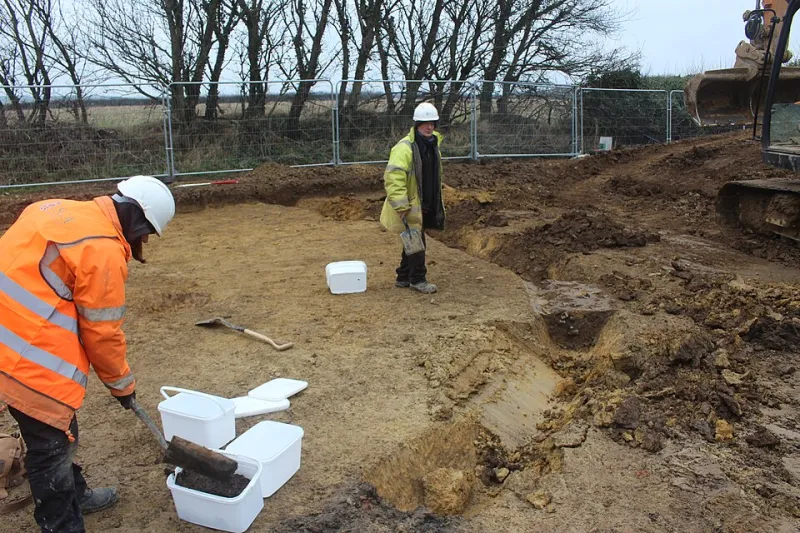
The challenge to Clovis primacy gained serious traction in the 1990s with the definitive investigation of Monte Verde, a waterlogged site in southern Chile. Excavations led by archaeologist Tom Dillehay produced well-preserved organic materials — wooden structures, food remains, cordage — associated with human occupation dating to approximately 14,500 years ago. The site's stratigraphic integrity was carefully documented, and a team of skeptical peer reviewers ultimately validated the findings. Monte Verde's age posed an immediate geographic problem for the Clovis-first model: if people were in southern Chile more than 14,000 years ago, they could not plausibly have descended from a Clovis population that entered North America around 13,000 years ago.
In North America, the site generating perhaps the most intense current debate is Chiquihuite Cave in the highlands of Zacatecas, Mexico. A 2020 study published in Nature reported lithic artifacts from stratigraphic layers dated to between 26,000 and 19,000 years ago — deep within the Last Glacial Maximum, a period when the Beringian land route and any interior corridor through North America would have been environmentally hostile or impassable. The stone tools described from Chiquihuite are unlike Clovis points and unlike any other well-documented North American lithic tradition, which has prompted both excitement and considerable skepticism. Critics have questioned whether the objects are genuinely artifacts or naturally fractured stones, and debate over the site's interpretation remains active.
Closer to home, the Meadowcroft Rockshelter in southwestern Pennsylvania has been a contested pre-Clovis candidate since the late 1970s. Excavator James Adovasio documented cultural materials in stratigraphic contexts that he argued dated to at least 16,000 years ago, possibly earlier. The site's radiocarbon chronology has been disputed on the grounds that ancient coal particles in the sediments may have introduced carbon contamination that made the dates appear older than they truly are. Defenders of the Meadowcroft dates maintain that the contamination hypothesis has been adequately addressed, and the site continues to figure prominently in pre-Clovis discussions.
The Coastal Migration Hypothesis
Part of what has made the pre-Clovis debate so productive is that it has prompted researchers to think more creatively about the routes by which people might have entered the Americas. The traditional interior corridor model — movement through an ice-free passage between the Laurentide and Cordilleran ice sheets — has come under increasing scrutiny. Paleoenvironmental reconstructions suggest that while the corridor was physically open by around 13,000 years ago, it may not have been ecologically productive enough to support human passage until somewhat later.
This has elevated the standing of the kelp highway hypothesis, which proposes that early maritime peoples moved southward along the Pacific coastline, exploiting the rich and relatively stable marine and coastal ecosystems that persisted even during glacial maxima. Proponents point to the genetic and morphological diversity of early American skeletal populations, the presence of early sites along the Pacific rim, and analogies with the documented maritime capabilities of Ice Age peoples in other parts of the world.
Testing this hypothesis archaeologically is exceptionally difficult. Sea levels during the Last Glacial Maximum were dramatically lower than today, meaning that any coastal campsites occupied by early migrants would now lie submerged beneath the Pacific Ocean, often at depths that make systematic investigation challenging. A small number of underwater archaeological surveys off the coasts of California and the Pacific Northwest have recovered submerged landscapes, but definitive pre-Clovis coastal sites remain elusive.
Genetic Evidence and Its Limits
Ancient DNA research has added important, if complex, information to the debate. Genomic studies of early American skeletal remains and modern Indigenous populations have identified population structure and divergence patterns consistent with an initial peopling event predating Clovis, though the precise timing and number of founding migrations remain subjects of active analysis. Some genetic models support a single founding population that entered the Americas before 16,000 years ago; others accommodate multiple waves of migration.
Genetic data, however, cannot substitute for archaeological evidence of site occupation. A founding population event inferred from genomic divergence rates provides a statistical estimate, not a campfire or a stone tool. The relationship between genetic signals and the physical archaeological record requires careful interpretation, and researchers in both fields are working to develop more integrated analytical frameworks.
What the Debate Means for American Prehistory
The methodological stakes of this controversy are considerable. Radiocarbon dating, the workhorse of archaeological chronology, carries inherent uncertainties that become more consequential as sites approach or exceed 20,000 years in age. Distinguishing genuine artifacts from geofacts — naturally occurring stones that resemble worked tools — requires rigorous analysis and is subject to interpretive disagreement. Stratigraphic integrity, the assurance that materials found in a given layer were actually deposited at the same time, must be demonstrated rather than assumed.
These are not merely technical quibbles. They reflect the discipline's hard-won commitment to evidentiary standards that protect the field from premature conclusions. The history of American archaeology includes episodes in which spectacular claims about early occupation dissolved under scrutiny, and that record appropriately makes researchers cautious.
Nevertheless, the weight of current evidence suggests that the Clovis-first model, in its original strict form, is no longer defensible. The more productive questions now concern not whether pre-Clovis populations existed, but when they arrived, by what routes, in what numbers, and with what cultural and technological repertoires. Each new well-documented site, each refined genetic analysis, and each improved dating technique brings the field incrementally closer to answers that will, in turn, generate new questions. That is precisely how the discipline is supposed to work.