Decoding Ancient Ancestry: How Paleogenomics Is Reshaping What We Know About Pre-Columbian North America
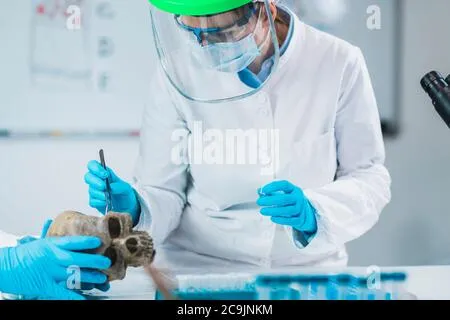
Photo: ancient DNA laboratory archaeologist analyzing skeletal remains genetics research, via l450v.alamy.com
For much of the twentieth century, the story of humanity's arrival in the Americas was told primarily through stone tools, burial mounds, and stratigraphic soil layers. Archaeologists relied on the physical record alone—painstakingly catalogued and debated across generations of fieldwork. That methodological framework, while enormously productive, has been fundamentally altered by a technology its practitioners could scarcely have imagined: the direct sequencing of ancient human genomes extracted from skeletal remains thousands of years old.
Paleogenomics—the study of genetic material recovered from archaeological specimens—has introduced a new evidentiary dimension to American archaeology. It has confirmed some established theories, overturned others, and introduced puzzles that neither genetics nor traditional archaeology can yet fully resolve.
The Science Beneath the Surface
Extracting usable DNA from ancient remains is an extraordinarily delicate process. Organic material degrades rapidly, particularly in warm or humid environments, meaning that well-preserved specimens from arid regions or permafrost deposits yield the most reliable results. Researchers isolate short fragments of mitochondrial or nuclear DNA, sequence them using next-generation platforms, and compare the results against reference populations both ancient and modern.
The field gained significant momentum in 2018 when a landmark study published in Nature analyzed the genomes of more than 160 ancient individuals from across the Americas, spanning a timeframe from roughly 10,000 to 2,000 years ago. The findings suggested that the peopling of the Americas was considerably more complex than a single migratory wave crossing the Bering Land Bridge. Instead, the data pointed toward multiple dispersal events, population replacements, and long-distance interactions that had left no obvious trace in the material record alone.
Subsequent studies have reinforced this picture of complexity. Research focusing on the ancient Kennewick Man—whose remains, recovered from the banks of the Columbia River in Washington State in 1996, sparked one of American archaeology's most contentious legal battles—ultimately demonstrated through genomic analysis that he was ancestrally connected to contemporary Native American populations, a finding that directly informed the repatriation debate surrounding his remains.
Migration Routes Reconsidered
The traditional Clovis-first model, which proposed that the first Americans arrived via a single ice-free corridor between the Laurentide and Cordilleran ice sheets approximately 13,000 years ago, has faced mounting pressure from both genetic and archaeological sources. Genomic data now lends considerable support to the coastal migration hypothesis, suggesting that some populations may have traveled southward along the Pacific coastline well before interior routes became passable.
A 2021 study examining ancient genomes from individuals associated with the Channel Islands off the coast of Southern California found evidence of a distinct ancestral lineage that diverged early from other North American populations. These findings align with archaeological evidence of maritime adaptations in the region and suggest that coastal environments served as critical pathways for early human dispersal rather than peripheral zones of secondary settlement.
Further east, genetic research has begun to illuminate the demographic history of the Mississippian culture, the sophisticated mound-building civilization that flourished across the central and southeastern United States between approximately 800 and 1600 CE. Studies of ancient DNA from sites including Cahokia—located near present-day St. Louis and once home to a population rivaling contemporary London—have revealed patterns of both genetic continuity and disruption that correspond with periods of political consolidation and decline visible in the material record.
Ethical Terrain as Complex as the Science
The power of paleogenomics comes with significant moral weight. Indigenous communities across the United States have raised substantive objections to the extraction and analysis of genetic material from ancestral remains, citing concerns that range from the spiritual to the epistemological. For many Native nations, the dead are not research subjects; they are relatives, and their disturbance—regardless of scientific intent—constitutes a violation of cultural and religious integrity.
The Native American Graves Protection and Repatriation Act (NAGPRA), enacted in 1990, established a federal framework for the return of human remains and cultural objects held by institutions receiving federal funding. However, the law's application to ancient DNA research has remained a contested gray area. Some institutions have proceeded with genomic studies on collections subject to repatriation claims, prompting formal protests and, in several cases, litigation.
The scientific community has responded—unevenly—by developing consultation frameworks intended to bring Indigenous communities into the research process as partners rather than subjects. The Sioux Chef collaborative model, pioneered in part through partnerships between tribal nations and university researchers in the Dakotas, represents one approach: tribal representatives participate in study design, retain veto authority over publication, and receive primary access to results before they enter the academic literature.
Other tribes have moved further, establishing their own genomic research programs staffed by Indigenous scientists and governed by tribal councils. The Cherokee Nation's genealogical and genetic heritage initiative, launched in partnership with tribal college programs, exemplifies a growing movement toward what scholars have termed "Indigenous data sovereignty"—the principle that communities retain ownership and interpretive authority over information derived from their members and ancestors.
Convergence and Caution
The most productive developments in this field have emerged at the intersection of genomic data, traditional archaeological analysis, and Indigenous oral histories. When all three lines of evidence converge—when genetic signals of population movement align with shifts in ceramic traditions and with tribal narratives of migration—the resulting interpretations carry a depth and credibility that no single discipline could achieve independently.
At the same time, researchers have urged caution against treating genetic data as a definitive arbiter of identity or ancestry. Genome sequences can establish biological relationships and trace population movements, but they cannot capture the full complexity of cultural affiliation, kinship systems, or the lived meanings communities attach to their own histories. A genome is not a biography.
As sequencing technology continues to advance and institutional relationships with Indigenous communities mature, the field of American archaeology stands at a genuinely transformative moment. The questions being asked today—about who arrived first, how populations interacted across vast distances, and how ancient peoples responded to environmental and social upheaval—are not merely academic. They speak directly to ongoing conversations about land rights, federal recognition, and the nature of historical justice in the United States.
The ancient dead, it turns out, still have much to say. The challenge for contemporary scholars is learning to listen with both scientific rigor and cultural humility.