Lost in Translation: Why America's Most Significant Archaeological Discoveries Rarely Reach the Public
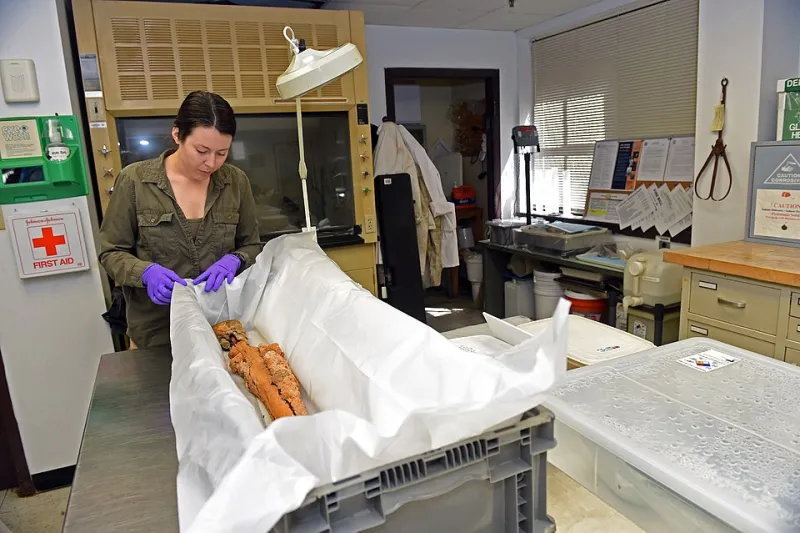
Photo: Official U.S. Navy Page from United States of America Arif Patani/U.S. Navy, Public domain, via Wikimedia Commons
A Discovery That Changed Everything—That Almost No One Knows About
In the late 1990s, excavations at the Topper Site in Allendale County, South Carolina, produced lithic artifacts from sediment layers dating potentially to 50,000 years before present—tens of thousands of years before the accepted Clovis-first model of human arrival in the Americas. Archaeologist Albert Goodyear and his team published their findings in peer-reviewed venues and presented at professional conferences. The archaeological community took notice. The general public, by and large, did not.
Topper is not an anomaly. It is a pattern. Across the United States, excavations are producing evidence that fundamentally revises long-held assumptions about who lived here, when they arrived, and how they organized their societies. Yet the overwhelming majority of these findings never penetrate the cultural membrane that separates academic discourse from everyday awareness. Understanding why requires examining a set of interlocking structural problems that have calcified over decades within the discipline.
The Academic Silo Problem
Archaeology, like most scientific disciplines, communicates primarily through peer-reviewed journals, monographs, and conference presentations—formats designed for specialists and largely inaccessible to non-specialists. The American Antiquity, the Journal of Archaeological Science, and comparable publications represent the field's gold standard for scholarly communication. They are also, practically speaking, invisible to the public.
Subscription costs alone present a formidable barrier. Individual access to a single journal article can run upward of forty dollars. Institutional subscriptions, available to university affiliates, are rarely extended to curious members of the general public. Open-access publishing has made modest inroads, but the transition has been slow and uneven across the discipline.
Beyond access, there is the matter of language. Archaeological literature is written for audiences already fluent in the field's specialized vocabulary—lithic reduction sequences, isotopic fractionation, palynological assemblages. This is not a criticism; technical precision is essential to scientific communication. It is, however, an acknowledgment that peer-reviewed prose is not designed to travel beyond its intended readership without significant translation work that rarely gets done.
Funding Structures That Reward Excavation, Not Explanation
Grant mechanisms in American archaeology are structured almost entirely around the research process itself—field seasons, laboratory analysis, radiocarbon dating, report preparation. The National Science Foundation, the primary federal funder of archaeological research, allocates resources for discovery and documentation. Comparatively little funding infrastructure exists to support the subsequent work of communicating those discoveries to non-academic audiences.
This creates a perverse incentive landscape. A researcher who secures a substantial NSF grant to excavate a Mississippian-period site in the Illinois River Valley will spend years producing findings of genuine historical significance. Upon publication, their professional obligations are largely fulfilled. The translation of that work into accessible formats—museum exhibits, documentary partnerships, public lectures, digital content—falls outside the grant's scope and, often, outside the researcher's available time and institutional support.
University promotion and tenure systems compound the problem. Scholarly publications advance careers. Public outreach, however valuable, rarely carries equivalent professional weight in hiring and promotion decisions. The rational response for an early-career archaeologist navigating a competitive job market is to prioritize the outputs that count—which means public communication is perpetually deferred.
Case Study: The Poverty Point Paradox
Poverty Point, a monumental earthwork complex in northeastern Louisiana, represents one of the most architecturally ambitious construction projects in pre-Columbian North America. Built by a hunter-gatherer society approximately 3,400 years ago, the site features concentric semicircular ridges spanning nearly three-quarters of a mile in diameter. Its construction required the coordinated labor of thousands of people across generations and implies a level of social organization that challenges conventional assumptions about non-agricultural societies.
Poverty Point received UNESCO World Heritage designation in 2013. It has been the subject of sustained archaeological investigation for over sixty years. And yet, in surveys of American adults asked to name significant pre-Columbian sites in the United States, it barely registers. Cahokia and Mesa Verde, both of which benefit from robust visitor infrastructure and decades of popular press coverage, consistently dominate public awareness. Poverty Point—arguably more archaeologically anomalous and therefore more scientifically interesting—remains largely confined to academic consciousness.
The reasons are instructive. Poverty Point lacks the visual drama of cliff dwellings or pyramid-like mounds that photograph well for magazine spreads. Its significance is statistical and interpretive—you have to understand what hunter-gatherer societies are supposed to look like before you can appreciate how radically Poverty Point departs from that model. That kind of contextual knowledge requires exactly the sort of science communication infrastructure that American archaeology has never systematically built.
The Media Gatekeeping Function
When archaeological discoveries do attract mainstream media attention, the selection process is rarely driven by scientific significance. News cycles favor the visually spectacular, the narratively simple, and the emotionally resonant. A well-preserved mummy, a cache of gold artifacts, or a site with a connection to a well-known historical event will reliably generate coverage. A revised understanding of lithic technology in the Great Basin will not.
Science journalists capable of translating complex archaeological findings for general audiences are a shrinking professional category. Newsroom budget cuts over the past two decades have eliminated dedicated science desks at many regional and national outlets. The reporters who cover archaeology today often do so as a secondary beat, without the specialized background needed to assess which findings are genuinely transformative and which are routine.
Social media has partially filled the void, enabling researchers to communicate directly with public audiences. But algorithmic dynamics on major platforms reward emotional engagement over analytical depth, creating pressures that are not always compatible with the careful, qualified language that responsible science communication requires.
Toward a More Communicative Discipline
None of this is inevitable. Several institutional interventions could meaningfully close the gap between discovery and public awareness.
Funding agencies could require public communication components in research grants, similar to the broader impacts criterion already embedded in NSF review processes—but with more substantive expectations and dedicated budget lines. Universities could formally recognize public scholarship in promotion and tenure evaluations, removing the career disincentive that currently discourages outreach. Open-access mandates for federally funded research would eliminate the paywall barrier at minimal cost to research quality.
Professional organizations like the Society for American Archaeology could invest more heavily in science communication training for graduate students and early-career researchers. Partnerships with public media organizations—museums, public radio, documentary producers—could create durable pipelines for translating significant findings into accessible formats.
Perhaps most importantly, the discipline could develop a more explicit ethic around public communication—one that treats the translation of knowledge as a professional responsibility rather than an optional supplement to the real work of research.
What Is Lost When Knowledge Stays Hidden
The stakes of this communication failure extend beyond academic reputation. Public understanding of American prehistory shapes how citizens relate to the land, to Indigenous communities, and to the deeper history of the continent they inhabit. When transformative discoveries remain confined to specialist journals, that understanding is impoverished—built on outdated textbook narratives rather than the richer, more complex picture that contemporary archaeology has assembled.
The past is not a fixed quantity. Every field season has the potential to revise what we thought we knew. But revision only matters if the revised understanding eventually reaches the people whose conception of history it is meant to correct. Right now, too much of what archaeology knows is being unearthed and then, in a meaningful sense, reburied—filed away in publications that the public will never read, about places the public will never visit, contributing to a conversation the public was never invited to join.

